
Article Plan: Bible Chapters and Verses List PDF
This article details comprehensive guides to Bible chapter and verse listings in PDF format. It explores the benefits, structure, resources, and practical usage of these invaluable tools for biblical study, ensuring accessibility.
Bible chapter and verse lists, particularly in PDF format, serve as fundamental resources for anyone engaging with scripture. These lists meticulously catalog each book of the Bible, detailing the number of chapters within each, and subsequently, the verses contained within those chapters. They are more than just simple enumerations; they are navigational tools, enabling swift and precise location of specific passages for study, sermon preparation, or personal devotion.
The utility of a well-structured list extends to various levels of biblical engagement. For beginners, it provides a clear overview of the Bible’s scope and organization. Experienced scholars utilize them for cross-referencing and in-depth textual analysis. The PDF format enhances accessibility, allowing for offline viewing and easy portability across devices. Genesis, for example, with its 50 chapters, becomes readily navigable with a dedicated list.
These lists aren’t new; they’ve been integral to biblical scholarship for centuries, but the digital PDF format offers a modern convenience, streamlining the process of exploring the sacred text.
Why Use a PDF List of Bible Chapters and Verses?
Employing a PDF list of Bible chapters and verses offers numerous advantages for diligent study and convenient access. Firstly, PDFs are universally accessible, functioning seamlessly across various devices – smartphones, tablets, computers – without requiring an internet connection. This offline availability is crucial for study during travel or in areas with limited connectivity;
Secondly, PDFs maintain formatting consistency, ensuring the list appears as intended regardless of the viewing platform. This is particularly helpful for detailed study where visual clarity is paramount. Consider Genesis, with its 50 chapters; a PDF provides a stable, organized view.
Furthermore, PDFs are easily searchable, allowing users to quickly locate specific books or chapters. They are also printable, offering a tangible resource for those who prefer a physical copy. The compact nature of a PDF makes it simple to store and share, fostering collaborative study and making biblical resources readily available to others.
Understanding the Structure of the Bible
Grasping the Bible’s structure is fundamental when utilizing chapter and verse lists, especially in PDF format. The Bible is broadly divided into two main sections: the Old Testament and the New Testament. The Old Testament, comprising 39 books, details the covenant between God and the Israelites, culminating in prophecies anticipating the Messiah. Books like Genesis (50 chapters) and Isaiah (66 chapters) form its core.
The New Testament, consisting of 27 books, focuses on the life, teachings, death, and resurrection of Jesus Christ, and the establishment of the Christian Church. Key books include Matthew (28 chapters) and John (21 chapters).

Each Testament is further organized into books, which are then divided into chapters, and finally, into verses. This hierarchical structure allows for precise referencing and facilitates in-depth study. A PDF list effectively maps this structure, providing a clear overview and enabling efficient navigation through the biblical text. Understanding this framework enhances the utility of any chapter and verse resource.
Old Testament Overview
The Old Testament, foundational to both Jewish and Christian faiths, comprises 39 books presenting a historical and prophetic narrative. It’s broadly categorized into the Law (Pentateuch – Genesis, Exodus, Leviticus, Numbers, Deuteronomy), Historical Books, Poetic and Wisdom Literature, and Prophetic Books.
Genesis, with its 50 chapters, lays the groundwork for creation, the fall of humanity, and God’s covenant with Abraham. Exodus (40 chapters) details the Israelites’ liberation from Egyptian slavery and the giving of the Law. The Psalms, a collection of 150 chapters, offer prayers, hymns, and expressions of faith. Isaiah, spanning 66 chapters, contains powerful prophecies about the Messiah.
A PDF list of Old Testament chapters and verses provides a structured roadmap through these diverse texts. It aids in locating specific passages for study, sermon preparation, or devotional reading. Recognizing the Old Testament’s historical context and literary genres enhances comprehension when using such a resource.
New Testament Overview
The New Testament, consisting of 27 books, centers on the life, teachings, death, and resurrection of Jesus Christ, and the early Christian church’s establishment. It’s divided into the Gospels (Matthew, Mark, Luke, John), Acts, Epistles (letters), and Revelation;
Matthew, with 28 chapters, presents Jesus as the promised Messiah fulfilling Old Testament prophecies. John (21 chapters) offers a unique theological perspective on Jesus’ divinity. The book of Acts chronicles the Holy Spirit’s empowerment of the apostles and the church’s expansion. Paul’s epistles provide doctrinal instruction and practical guidance for believers.
A PDF list of New Testament chapters and verses is invaluable for navigating this crucial section of the Bible. It facilitates quick access to specific verses for personal study, group discussions, or theological research. Understanding the historical and cultural context of the New Testament enhances the effectiveness of utilizing such a resource.
Key Books and Their Chapter Counts
A readily available PDF list detailing chapter counts is essential for efficient Bible study. Knowing the length of each book provides context and helps estimate reading time. Several books stand out due to their significant length or theological importance.
Genesis, the first book, comprises 50 chapters, narrating creation, the fall, and the patriarchs. Exodus, with 40 chapters, recounts the Israelites’ liberation from Egypt and the giving of the Law. The book of Psalms, a collection of hymns and prayers, boasts an impressive 150 chapters.
Among the prophetic books, Isaiah contains 66 chapters, offering profound insights into God’s judgment and salvation. In the New Testament, Matthew (28 chapters) and John (21 chapters) provide crucial accounts of Jesus’ life and ministry. A comprehensive PDF resource will list these and all other books, streamlining your exploration of scripture.
Genesis ─ 50 Chapters
The Book of Genesis, spanning 50 chapters, forms the foundational narrative of the Bible. A detailed PDF list highlighting its chapter breakdown is invaluable for focused study. Genesis recounts the creation of the world, the introduction of sin through Adam and Eve, and the subsequent consequences for humanity.
It traces the lineage from Adam to Noah, detailing the great flood and God’s covenant with Noah. The narrative then focuses on Abraham, Isaac, and Jacob – the patriarchs of the Israelite nation – and their journeys of faith. Each chapter contributes to the overarching story of God’s plan for redemption.
A PDF resource allows quick access to specific events, like the Tower of Babel (Genesis 11) or Joseph’s story (Genesis 37-50). Understanding the chapter divisions aids in grasping the book’s structure and thematic development, enhancing comprehension and retention.
Exodus ─ 40 Chapters
The Book of Exodus, comprised of 40 chapters, details the Israelites’ liberation from Egyptian slavery and their journey to Mount Sinai. A comprehensive PDF list of its chapters provides a structured approach to studying this pivotal period in biblical history. Exodus begins with the Israelites’ oppression and God’s call to Moses.

The ten plagues demonstrate God’s power over the Egyptian gods, culminating in the Passover and the Exodus itself. The subsequent chapters describe the crossing of the Red Sea and the wilderness wanderings, where God provides for His people. At Mount Sinai, God delivers the Ten Commandments and establishes the covenant law.
A PDF resource facilitates pinpointing specific events, such as the construction of the Tabernacle (Exodus 25-40) or the giving of the law (Exodus 19-24). Chapter breakdowns reveal the book’s thematic organization, aiding in understanding God’s faithfulness and the establishment of His relationship with Israel.
Psalms ⏤ 150 Chapters
The Book of Psalms, a collection of 150 chapters, represents a diverse range of poetic expressions – hymns, laments, thanksgiving, and royal psalms. A detailed PDF list of Psalms chapters is invaluable for navigating this rich tapestry of worship and emotion. These poems cover the full spectrum of human experience, offering solace, praise, and guidance.
The Psalms are traditionally attributed to authors like David, Asaph, and the sons of Korah, though authorship is debated for some. They were likely used in temple worship and personal devotion. A PDF allows quick access to specific psalms for prayer, meditation, or study. Categorizing by theme – such as Psalms of ascent (120-134) – becomes easier.
Having a chapter-by-chapter PDF resource aids in recognizing recurring motifs, like God’s sovereignty, the importance of righteousness, and the hope of redemption. It facilitates deeper engagement with the poetic language and theological depth of this beloved biblical book, enhancing spiritual growth.
Isaiah ─ 66 Chapters
The Book of Isaiah, spanning 66 chapters, is a major prophetic book within the Old Testament, renowned for its profound messianic prophecies and vivid imagery. A comprehensive PDF list of Isaiah’s chapters is crucial for studying its complex themes of judgment, salvation, and the coming Messiah. The book is generally divided into three main sections: Proto-Isaiah, Deutero-Isaiah, and Trito-Isaiah, each with distinct focuses.
Isaiah delivers messages of warning to Judah and Israel, calling them to repentance while also offering hope for future restoration. A PDF format allows for easy cross-referencing of prophecies and their fulfillments in the New Testament. Key themes include God’s holiness, the futility of idolatry, and the promise of a righteous remnant.
A chapter-specific PDF resource streamlines the study of Isaiah’s intricate structure and poetic style, enabling deeper understanding of its enduring relevance. It’s an invaluable tool for both scholarly research and personal devotional reading, unlocking the book’s powerful message of faith and redemption.
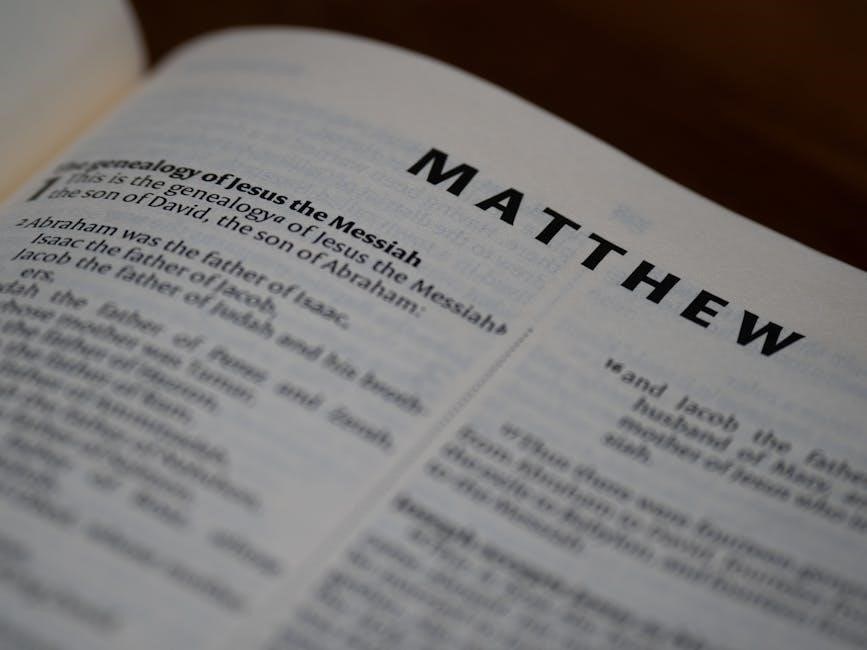
Matthew ─ 28 Chapters
The Gospel of Matthew, comprising 28 chapters, stands as the first book of the New Testament, presenting Jesus Christ as the promised Messiah and King of the Jews. A detailed PDF list of Matthew’s chapters is essential for navigating its carefully constructed narrative, tracing the lineage of Jesus and fulfilling Old Testament prophecies.
Matthew skillfully blends Jewish tradition with universal appeal, emphasizing Jesus’ teachings, miracles, and ultimately, His death and resurrection. The Sermon on the Mount, found in chapters 5-7, is a cornerstone of Christian ethics. A PDF format facilitates focused study of specific themes like discipleship, forgiveness, and the Kingdom of Heaven.
Having a chapter-by-chapter PDF resource allows for efficient tracking of Jesus’ interactions with various groups, including Pharisees, Sadducees, and Roman authorities. It’s an invaluable aid for both individual reflection and group Bible studies, deepening comprehension of Matthew’s powerful portrayal of Jesus’ life and ministry.
John ─ 21 Chapters
The Gospel of John, consisting of 21 chapters, uniquely presents Jesus Christ as the divine Son of God, emphasizing His deity and eternal existence. A readily accessible PDF list of John’s chapters is crucial for studying its distinctive theological depth and symbolic language, differing significantly from the synoptic Gospels.
John’s narrative focuses on “signs” – miracles performed by Jesus – intended to reveal His glory and inspire belief. Key events like the wedding at Cana, the healing of the man born blind, and the raising of Lazarus are meticulously documented. A PDF format allows for easy cross-referencing and thematic analysis of these pivotal moments.
The extended discourses in John, particularly Jesus’ farewell speeches in chapters 13-17, offer profound insights into His relationship with the Father and His love for His disciples. A chapter-specific PDF resource streamlines the study of these complex passages, fostering a deeper understanding of John’s unique perspective on Jesus’ identity and mission.
Finding Reliable PDF Resources
Locating trustworthy PDF lists of Bible chapters and verses requires careful consideration. Numerous websites offer these resources, but verifying their accuracy and source is paramount. Reputable Bible societies, theological institutions, and established Christian publishers are excellent starting points for finding dependable PDFs.
Websites like Bible Gateway, Blue Letter Bible, and Logos Bible Software often provide downloadable chapter lists or links to reliable PDF versions. Always check for clear copyright information and ensure the PDF is free from intrusive advertisements or potentially harmful software. Prioritize resources that align with established biblical translations.
Beware of unofficial sources or those promoting specific theological agendas. Cross-referencing information with multiple sources is a wise practice. Look for PDFs that are regularly updated to reflect the latest scholarship and textual revisions. A reliable PDF should accurately represent the chapter and verse divisions of the chosen Bible translation.
Features to Look for in a Bible Chapter/Verse PDF
When selecting a Bible chapter and verse PDF, several key features enhance usability and study efficiency. A search functionality is crucial, allowing quick location of specific books, chapters, or even keywords within the text. This saves considerable time compared to manual scrolling.
Effective book and chapter navigation is equally important. Hyperlinked tables of contents or internal links enable seamless movement between different sections of the Bible. A well-organized PDF should allow easy jumping to desired passages.
Consider PDFs with clear formatting and legible fonts. Features like bookmarks for frequently studied books or chapters can be incredibly helpful. Some advanced PDFs may even include cross-references or concordances. Prioritize PDFs that are optimized for readability on various devices – computers, tablets, and smartphones – ensuring a consistent and comfortable reading experience.
Search Functionality
A robust search functionality is paramount within any effective Bible chapter and verse PDF. This feature transcends simple keyword searches, enabling users to pinpoint specific verses, phrases, or even words across the entire biblical text with remarkable speed and accuracy.
Ideally, the search should be case-insensitive, returning results regardless of capitalization. Advanced search options, such as searching for exact phrases or multiple keywords simultaneously, further enhance its utility. The ability to search within a specific book or range of chapters narrows results and improves efficiency.
A well-implemented search function should highlight search terms within the text, making them easily identifiable. Quick access to search results via a dedicated panel or list streamlines the study process. This feature is invaluable for in-depth biblical research, topical studies, and quickly locating relevant passages.

Book and Chapter Navigation
Seamless book and chapter navigation is crucial for a user-friendly Bible PDF experience. A clear, intuitive interface allows swift movement between books, chapters, and verses, mimicking the experience of a physical Bible. Hyperlinked tables of contents provide one-click access to any book within the PDF document, eliminating tedious scrolling.
Chapter selection should be straightforward, perhaps through dropdown menus or clickable chapter numbers. Bookmarks or a sidebar displaying the book structure offer a constant visual reference point. The ability to easily jump to the beginning or end of a book or chapter enhances navigation speed.
Ideally, the PDF should retain the user’s place, automatically returning to the last verse read. Interactive elements, like a mini-map of the Bible, can provide a broader contextual view. Efficient navigation transforms the PDF from a static document into a dynamic study tool.
Legal Considerations & Copyright
When utilizing Bible chapter and verse lists in PDF format, understanding copyright and legal aspects is paramount. While the biblical text itself is generally in the public domain, specific translations are protected by copyright. PDFs containing copyrighted translations require permission from the copyright holder for distribution.

Many free PDF versions utilize public domain translations like the King James Version. However, modern translations – NIV, ESV, NASB – typically have restrictions. Always verify the translation’s copyright status before sharing or modifying a PDF. Respecting intellectual property rights is crucial.
Some PDFs may include study notes or commentary, which are also subject to copyright. Commercial use of copyrighted PDFs without a license is prohibited; Attribution may be required even for public domain versions, acknowledging the source. Ensure compliance with all applicable laws and regulations.

Using PDFs on Different Devices
Bible chapter and verse lists in PDF format offer remarkable versatility across various devices. Smartphones and tablets, utilizing apps like Adobe Acrobat Reader, provide portable access for on-the-go study. PDFs scale well to smaller screens, though zooming may be necessary for detailed viewing.
Computers (Windows, macOS, Linux) readily support PDF viewing through web browsers or dedicated software. Larger screens enhance readability and facilitate easier navigation. Features like search and annotation are often more robust on desktop applications.
E-readers, such as Kindles, can display PDFs, but formatting may sometimes be compromised. Reflowing text isn’t always supported, potentially requiring horizontal scrolling. Consider converting the PDF to a more e-reader-friendly format if formatting issues arise. Accessibility features, like text-to-speech, vary by device and PDF reader.
Alternatives to PDF Lists

While PDF lists are convenient, several alternatives offer unique benefits for exploring Bible chapters and verses. Online Bible websites and apps, like Bible Gateway and YouVersion, provide searchable text, multiple translations, and interactive features – eliminating the need for downloads.
Dedicated Bible study software (e.g., Logos, Accordance) offers advanced tools like commentaries, concordances, and original language texts. These programs often include integrated chapter and verse lists, alongside extensive research capabilities.
Spreadsheet software (Excel, Google Sheets) allows for custom organization and analysis of chapter and verse data. Users can create personalized lists, track reading progress, or categorize verses by theme. Physical printouts remain a traditional option, offering a tactile experience and freedom from digital devices. Choosing the best alternative depends on individual study preferences and needs.