The ASRock Z270 Taichi manual details a high-performance motherboard supporting 7th/6th Gen Intel Core processors, DDR4 memory, and advanced features like Intel Optane.
Overview and Key Features
The ASRock Z270 Taichi, as outlined in its manual, boasts LGA 1151 socket compatibility for 7th and 6th Gen Intel Core processors. Key features include support for up to 64GB of DDR4 memory in dual channel, and utilizes the Intel Z270 chipset.
Furthermore, the manual highlights USB 3.1 Gen2 support and potential for Intel Optane Memory, enhancing system responsiveness.
Target Audience and Use Cases
According to the ASRock Z270 Taichi manual, this motherboard targets PC enthusiasts and gamers seeking high performance and overclocking capabilities. It’s ideal for builds requiring robust processing power and memory bandwidth.
The manual suggests use cases including high-end gaming rigs, content creation workstations, and systems benefiting from advanced storage solutions like Intel Optane Memory.

Unboxing and Component Identification
The ASRock Z270 Taichi manual lists package contents: motherboard, I/O shield, SATA cables, and a quick installation guide, alongside a support CD.
Package Contents
According to the ASRock Z270 Taichi manual, the box includes the ATX motherboard itself, a rear panel I/O shield for easy installation, several SATA data cables for connecting storage devices, and a quick installation guide to get you started.
Additionally, a support CD containing drivers and utilities is provided, offering comprehensive software resources for optimal performance and functionality.
Motherboard Layout and Connectors
The ASRock Z270 Taichi manual illustrates a standard connector layout, featuring two PCIe slots with ample spacing for larger coolers. The HD Audio header is positioned at the rear, while SATA ports face forward for easy access.
It supports LGA1151 processors and DDR4 memory, offering robust connectivity options for various components and peripherals.
Installation Guide
The ASRock Z270 Taichi manual guides users through CPU, RAM, and cooler installation, emphasizing the LGA 1151 socket and DDR4 memory support.
CPU Installation (LGA 1151 Socket)
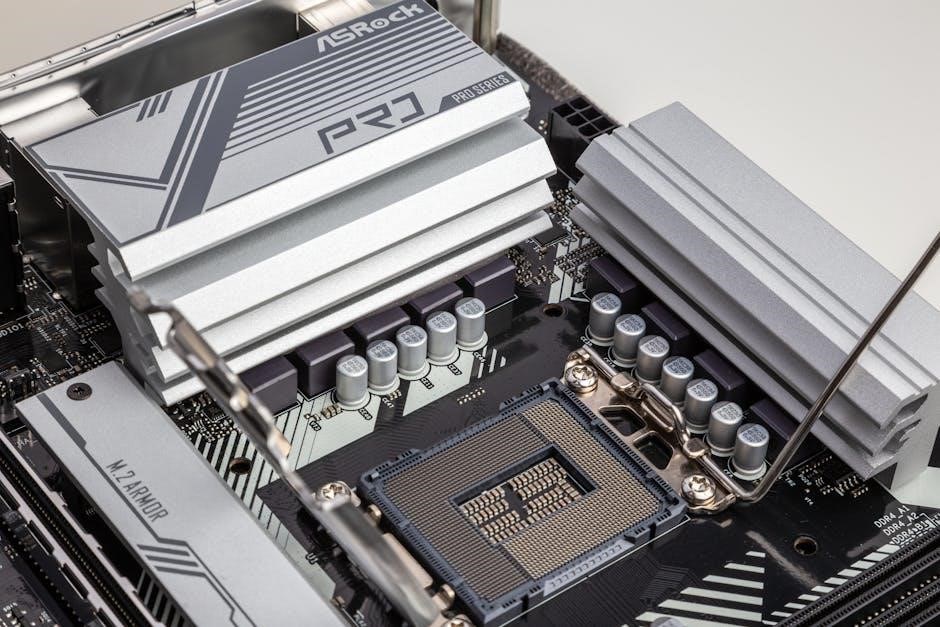
The ASRock Z270 Taichi manual instructs users to carefully align the CPU with the LGA 1151 socket, noting the golden triangle marking. Gently place the processor, avoiding bent pins. Secure the retention lever to firmly lock the CPU in place before proceeding with cooler installation.
RAM Installation (DDR4 Support)
The ASRock Z270 Taichi manual guides users to open the retaining clips on the DDR4 DIMM slots. Align the notch on the RAM module with the slot, then apply firm, even pressure until the clips click shut. Dual-channel configuration is supported; consult the manual for optimal slot placement.
Cooler Installation
The ASRock Z270 Taichi manual instructs users to install CPU coolers after RAM installation. Ensure the cooler is compatible with the LGA 1151 socket. Apply thermal paste if necessary, then securely mount the cooler using the provided brackets and screws, following the manual’s diagrams carefully.
BIOS Setup and Configuration
The ASRock Z270 Taichi manual guides users through BIOS access, interface navigation, and essential settings configuration for optimal system performance and stability.
Accessing the BIOS
According to the ASRock Z270 Taichi manual, entering the BIOS setup is typically achieved by pressing the “Del” key repeatedly during the system’s power-on self-test (POST).
Alternatively, the “F2” key can be used to directly access the BIOS setup utility. Ensure quick and repeated key presses immediately after powering on the motherboard for successful BIOS entry.
BIOS Interface Overview
The ASRock Z270 Taichi manual describes a user-friendly BIOS interface with distinct sections for system configuration, hardware monitoring, and overclocking adjustments.
Key areas include the Main screen for system information, the Advanced mode for detailed settings, the OC Tweaker section for performance tuning, and the Exit menu for saving changes.
Overclocking Settings
The ASRock Z270 Taichi manual details extensive overclocking options within the BIOS’s OC Tweaker section.
Users can adjust CPU ratios, voltages, and memory timings for enhanced performance. Features include Load-line Calibration, CPU Core Voltage control, and DRAM voltage adjustments, enabling stable and customized overclocking profiles.
Connectivity and I/O Ports
The ASRock Z270 Taichi manual illustrates a robust rear panel with USB 3.1 Gen2, audio jacks, and standard ports for diverse connectivity needs.
Rear Panel I/O Ports
According to the ASRock Z270 Taichi manual, the rear panel boasts a comprehensive array of ports. These include USB 3.1 Gen2 for rapid data transfer, alongside multiple USB 3.0 ports.
Additionally, you’ll find PS/2 ports for legacy devices, audio jacks supporting multi-channel sound, and standard LAN ports for network connectivity. Video outputs, like HDMI and DisplayPort, are also present for display connections.
Internal Connectors (USB, Fan Headers, etc.)
The ASRock Z270 Taichi manual highlights numerous internal connectors for expansion. These encompass USB 2.0 and 3.0 headers to add front panel connectivity, and multiple fan headers for robust cooling solutions.
SATA ports are readily available for storage devices, alongside connectors for case fans and a TPM header for enhanced security. The manual details their precise locations for easy system building.
Jumpers and Clear CMOS
The ASRock Z270 Taichi manual illustrates jumper settings, notably for clearing CMOS. A jumper cap placement dictates whether the jumper is short or open.
Jumper Locations and Functions
According to the ASRock Z270 Taichi manual, jumpers control various motherboard functions. The Clear CMOS jumper resets the BIOS to factory defaults, crucial for troubleshooting. Other jumpers might manage features like slow-mode switching for memory. The manual’s illustrations clearly depict jumper locations and their corresponding short/open configurations, essential for proper setup and system stability.
Clearing CMOS Instructions
The ASRock Z270 Taichi manual instructs users to clear CMOS by placing the jumper cap on the CLR_CMOS pins for a few seconds with the system powered off. This resets the BIOS settings to their defaults, resolving boot issues or failed overclocking attempts. Ensure the power supply is disconnected before proceeding for safety.
Software and Drivers
The ASRock Z270 Taichi manual provides links to download essential drivers and the A-Tuning utility for system monitoring and performance optimization.
Driver Installation
The ASRock Z270 Taichi manual emphasizes installing drivers from the provided CD or downloading the latest versions from the ASRock support website. This ensures optimal compatibility and performance for all onboard components. Prioritize chipset, audio, LAN, and graphics drivers for a stable system.
ASRock A-Tuning Utility
The ASRock Z270 Taichi manual highlights the A-Tuning utility for system monitoring, fan speed control, and voltage adjustments. This software allows users to easily overclock and optimize their system’s performance directly from within Windows. It provides a user-friendly interface for advanced settings.

Troubleshooting
The ASRock Z270 Taichi manual offers solutions for common issues, including a crucial check: ensure the motherboard battery maintains a 3.0V reading.
Common Issues and Solutions
The ASRock Z270 Taichi manual provides guidance for resolving typical problems. These include verifying proper component installation, addressing boot failures, and diagnosing USB connectivity issues. A low motherboard battery voltage (below 3.0V) is a frequently cited concern, requiring immediate replacement to maintain system stability and BIOS settings.
Motherboard Battery Check (3.0V)
The ASRock Z270 Taichi manual emphasizes the critical importance of the CMOS battery. It should consistently read 3.0V; any lower indicates depletion. A failing battery causes BIOS settings loss, boot failures, and potential system instability. Replacement is crucial for preserving configurations and ensuring reliable operation of the motherboard.
Safety Precautions
The ASRock Z270 Taichi manual stresses ESD protection during handling and installation. Proper grounding prevents component damage, ensuring system stability and longevity.
ESD Protection
Electrostatic discharge (ESD) can severely damage sensitive motherboard components. The ASRock Z270 Taichi manual recommends using an anti-static wrist strap grounded to the chassis. Always handle the motherboard by its edges, avoiding contact with gold connector pins or exposed circuits.
Handling and Storage
The ASRock Z270 Taichi manual advises storing the motherboard in its anti-static bag within a dry, static-free environment. Avoid stacking heavy objects on top of it. When handling, ensure a clean workspace and minimize physical stress on the PCB. Proper care prevents component damage during installation.
Manual Resources and Support
The ASRock Z270 Taichi manual is available as a downloadable PDF on the ASRock support website, offering comprehensive guidance and troubleshooting assistance.
Downloading the User Manual (PDF)
Accessing the ASRock Z270 Taichi user manual is straightforward; it’s readily available for download directly from the ASRock website. Users can find both global and China-specific versions in PDF format.
The downloadable manual provides detailed information on installation, BIOS configuration, troubleshooting, and specifications. A link is available at https://download.asrock.com/Manual/Z270 Taichi.pdf for easy access.
ASRock Support Website
The ASRock support website serves as a central hub for Z270 Taichi owners, offering extensive resources beyond the downloadable manual. Users can find FAQs, technical documentation, driver updates, and contact information for direct assistance.
ASRock’s website provides a platform to report issues, access organization information, and explore corporate social responsibility initiatives, ensuring comprehensive support for their products.
PCIe Slot Configuration
The ASRock Z270 Taichi manual explains PCIe slot speeds and compatibility, supporting multi-GPU configurations with adequate spacing for cooler installations.
PCIe Slot Speeds and Compatibility
According to the ASRock Z270 Taichi manual, the motherboard features multiple PCIe slots offering varying speeds depending on the installed components and configuration. It supports PCIe 3.0 x16 for graphics cards, ensuring optimal bandwidth for gaming and professional applications. The manual details how slot bandwidth may be shared when multiple devices are installed, impacting performance.
Multi-GPU Configurations
The ASRock Z270 Taichi manual explains support for multi-GPU setups, like NVIDIA SLI and AMD CrossFire, enhancing graphics performance. It details optimal slot configurations for dual-card setups, ensuring proper bandwidth allocation. The manual also notes potential limitations and recommends specific power supply requirements for stable multi-GPU operation.

SATA Port Configuration
The ASRock Z270 Taichi manual outlines SATA port locations, speeds, and RAID configuration options for storage devices, maximizing data transfer efficiency.
SATA Port Locations and Speeds
According to the ASRock Z270 Taichi manual, the motherboard features six SATA3 6.0 Gb/s ports, conveniently facing forward for easy cable management. These ports support RAID configurations for enhanced data protection and performance. The manual details specific port assignments and optimal connection practices.
RAID Configuration
The ASRock Z270 Taichi manual explains support for RAID 0, 1, 5, and 10 configurations using the integrated SATA ports. Detailed instructions guide users through BIOS setup for each RAID level, enhancing data redundancy or performance. The manual emphasizes backing up data before initiating any RAID setup.
Power Supply Considerations
The ASRock Z270 Taichi manual recommends a sufficient wattage power supply, detailing connector locations for reliable system operation and component compatibility.
Recommended Power Supply Wattage
The ASRock Z270 Taichi manual doesn’t explicitly state a minimum wattage, but recommends a power supply capable of handling the installed components. Consider at least 600W for a basic setup, increasing to 750W or higher for multi-GPU configurations or heavily overclocked processors.
Power Connector Locations
The ASRock Z270 Taichi manual illustrates a standard ATX power supply connection layout. This includes a 24-pin ATX power connector, an 8-pin EPS connector for the CPU, and additional PCIe power connectors near the expansion slots for graphics cards.
Advanced Features
The ASRock Z270 Taichi manual highlights support for Intel Optane Memory and USB 3.1 Gen2, enhancing storage and data transfer capabilities.
Intel Optane Memory Support
The ASRock Z270 Taichi manual confirms compatibility with Intel Optane Memory, a system acceleration technology. This allows users to combine the affordability of traditional hard drives with the responsiveness and performance of SSDs.
Optane Memory intelligently caches frequently accessed data, significantly reducing load times and improving overall system speed. The manual provides guidance on proper installation and configuration for optimal performance gains.
USB 3.1 Gen2 Support
According to the ASRock Z270 Taichi manual, this motherboard features USB 3.1 Gen2 ports, delivering blazing-fast data transfer speeds up to 10Gbps. This is twice the speed of USB 3.0, enabling quicker file transfers and enhanced peripheral performance.
The manual details the location of these ports and provides information on ensuring compatibility with USB 3.1 Gen2 devices for maximum bandwidth utilization.